
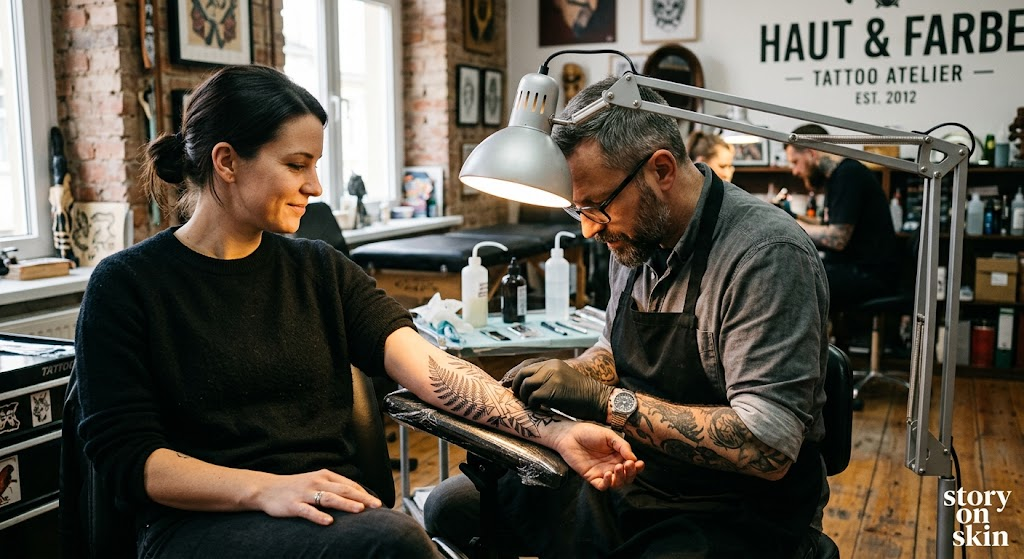
Even with the cleanest needle technique and the most disciplined aftercare, healed ink does not always settle with uniform saturation. Biological differences in skin density, accidental scabbing, or high-friction placements can leave minor color dropouts or faint line breaks. In the German tattoo landscape, this corrective pass is known universally as Nachstechen.
Is a touch-up included automatically in your original quote? What are the standard time limits to claim a free session, and when are you expected to pay a nominal fee?
Here is everything you need to know about the conventions, legalities, and studio etiquette surrounding tattoo touch-ups across Germany.
1. What Is “Nachstechen” and Why Is It Necessary?
Nachstechen refers to a focused, secondary tattoo session dedicated to refining healed lines, repacking areas where pigment flaked prematurely, or balancing uneven shading.
A touch-up is rarely an indictment of the artist’s skill. Skin is an organic, self-renewing canvas that responds unpredictably to foreign pigments:
- Cellular Regeneration: While the epidermis closes within 2 to 3 weeks, deep dermal healing and cellular pigment encapsulation take between 6 to 12 weeks.
- Natural Pigment Fall-Out: Areas over mobile joints, rough calloused skin, or zones with irregular subcutaneous fat often lose small micro-particles of ink during the peeling stage.
2. The Golden Rule: The 3-to-6 Month Grace Period
In Germany, the overwhelming majority of established studios and independent resident artists provide one complimentary touch-up (kostenloses Nachstechen) under clear conditions:
| Parameter | Standard Studio Baseline | Variations & Conditions |
| Eligibility Window | Within 3 to 6 months post-session | Allows skin to heal fully while remaining fresh enough to verify the work. |
| Material/Hygiene Fee | €0 (Complimentary) or €20–€30 | Some shops assess a nominal prep fee covering single-use sterile supplies. |
| Notification Requirement | Digital photo sent via email/DM | Artist assesses whether an in-person touch-up is clinically warranted. |
| Work Covered | Original design lines & fills only | Excludes design expansions, additions, or cover-up modifications. |
If you reach out to an artist a year or two after your original appointment, the complimentary window has expired. At that stage, any work is classified as regular maintenance or a new booking, billed under standard hourly rates or studio minimums.
3. High-Wear Placements: The Explicit No-Warranty Zones
Certain anatomical placements experience friction, constant water contact, and cellular shedding rates so elevated that ink rarely stays uniform. In German studios, artists almost universally classify the following zones as “No-Warranty Areas” (ohne Nachstech-Garantie):
- Hands & Fingers: Hand washing, detergent contact, and thin skin lead to rapid ink fallout. Touch-ups here are almost always charged at the shop’s standard rate.
- Palms & Soles of Feet: Epidermal turnover in these zones sheds ink rapidly; touch-ups rarely hold permanently.
- Inner Lip / Mucous Membranes: High moisture and natural friction wash away pigment within weeks to months.
- Feet, Heels & Ankles: Heavy shoe and sock abrasion during the early recovery phase causes localized fading.
Before tattooing these areas, German artists will have you sign a supplementary acknowledgement confirming that subsequent touch-ups are excluded from complimentary service terms.
4. Aftercare Negligence vs. Legitimate Pigment Loss
A critical boundary in German studio policy revolves around client compliance with written aftercare protocols (Pflegeanleitung).
- Legitimate Dermal Fall-Out: Crisp, clean lines that simply healed lighter due to skin density differences are happily corrected free of charge.
- Negligent Damage: If ink loss resulted from picking thick scabs, premature swimming (Schwimmbad/FKK), visiting tanning salons (Solarium), or intense sauna sessions during the first 4 weeks, the artist holds the right to bill you for the session. Picking scabs rips pigment directly out of the dermis and creates micro-scarring that takes twice as long to rework.
💡 Studio Tip & German Etiquette:
If you notice a faint spot, do not panic during the peeling stage. Wait a minimum of 4 to 6 weeks before messaging your artist. Freshly regenerated skin appears milky, shiny, or translucent (Silberhaut), which frequently obscures pigment that will become visible again once full keratinization concludes.
5. What About Guest Artists and Traveling Tattooers?
Booking with an international guest artist touring through Berlin or Frankfurt brings unique touch-up dynamics:
- No Local Guarantee: Unless the traveling guest makes regular, predictable returns to that specific studio, securing a local free touch-up is practically impossible once their tour concludes.
- Studio Hand-Offs: Some resident studios offer to have an in-house artist complete a minor touch-up on a guest piece for a standard hygiene setup fee (€30–€50), but they are not legally or contractually bound to service another artist’s work.
- Advance Clarification: Always ask your guest artist how they handle touch-ups should ink drop out after you part ways.
Frequently Asked Questions (FAQ)
Does a touch-up hurt as much as the initial tattoo?
Generally, no. Touch-up appointments are brief—rarely exceeding 15 to 30 minutes—and focus strictly on patchy segments rather than retracing the entire motif. However, working over freshly mature skin can feel slightly sharper, so approach the session well-hydrated.
Should I tip an artist for a free touch-up?
Yes. Although the labor and materials may be covered under warranty, tipping €10 to €20 (or bringing a small espresso/snack token) shows appreciation for the artist opening a sterile station and setting aside calendar time for you without charging an hourly rate.
How do I schedule a touch-up appointment properly?
Take a clear, sharp photo of the healed tattoo in natural window daylight (avoid harsh indoor flash). Email the photo to the studio alongside your original appointment date, the artist’s name, and a concise sentence pointing out the areas that need reinforcement.
About The Author
