
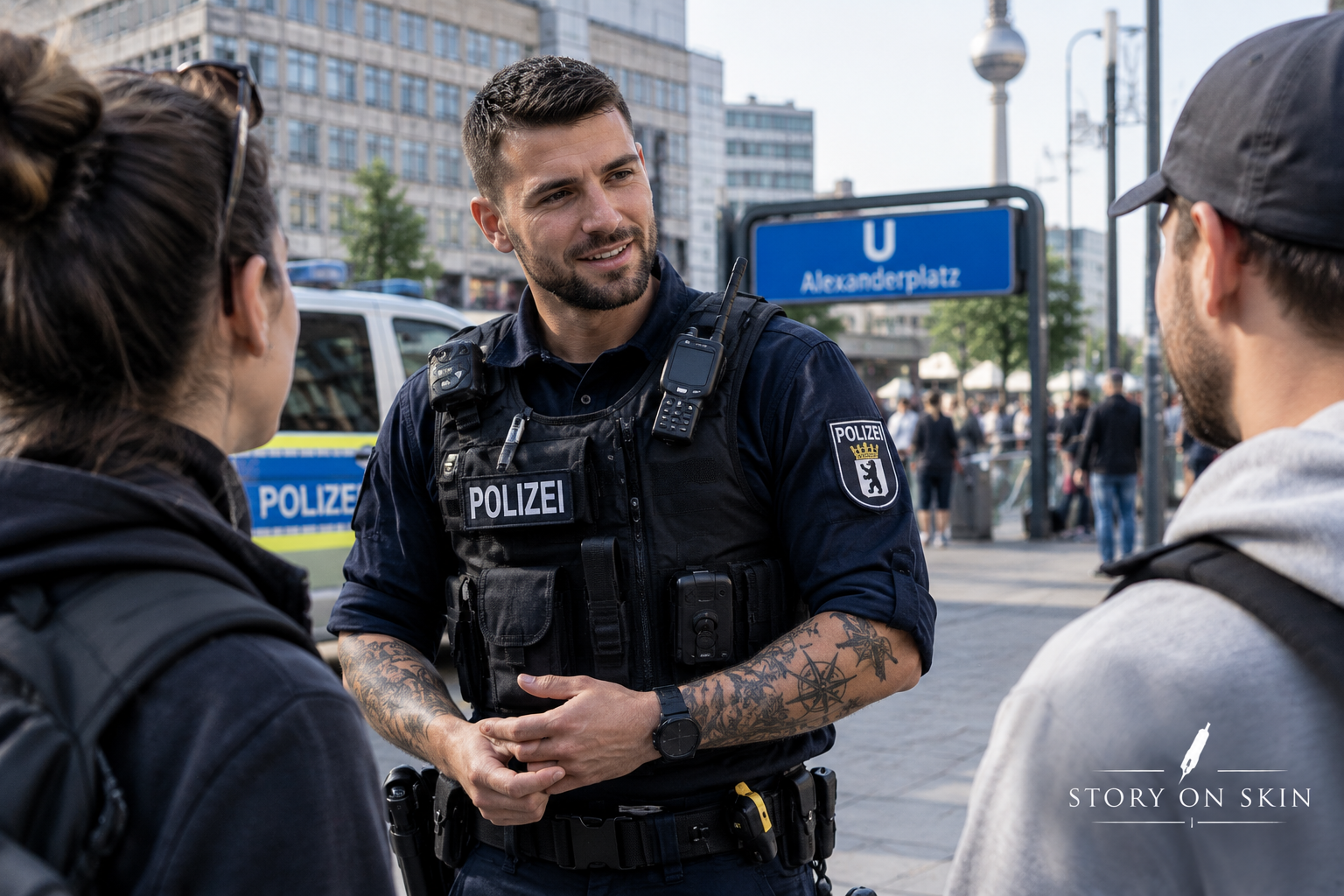
Over the past decade, body ink transitioned from an underground countercultural badge to a mainstream aesthetic shared by millions of Germans. Yet, for individuals pursuing careers in law enforcement, state administration, or the armed forces, body art remains a contested legal topic. The intersection of modern personal expression and the traditional constitutional duties of a German civil servant (Beamter) has sparked intense courtroom battles, legislative amendments, and shifting recruitment criteria.
Can you wear a full sleeve while patrolling the streets of Berlin or Munich? Does an unhidden forearm tattoo automatically disqualify an applicant from the Bundespolizei or the armed forces (Bundeswehr)?
Here is an analysis of German civil service appearance codes, regional police variances, armed forces directives, and strictly prohibited motifs.
1. The Constitutional Conflict: Personal Rights vs. State Neutrality
The legal debate over tattoos in the German public sector centers on two conflicting constitutional principles enshrined in the German Basic Law (Grundgesetz – GG):
- The Right to Free Development of Personality (Art. 2 Para. 1 GG): Every citizen possesses fundamental rights over their bodily autonomy and personal aesthetic appearance, including permanent skin modifications.
- The Principle of Institutional Neutrality & Respect (Art. 33 Para. 2 GG): Civil servants represent the sovereign authority of the democratic state (Hoheitsträger). Their external appearance must preserve public trust, political impartiality, and institutional authority.
Historically, administrative ministries relied on vague internal administrative decrees (Verwaltungsvorschriften) to reject tattooed candidates. However, a landmark ruling by the Federal Administrative Court (Bundesverwaltungsgericht) determined that blanket exclusions violated personal rights without explicit statutory authorization. Consequently, federal and state parliaments enacted formal appearance legislation (Erscheinungsbild-Gesetze) establishing concrete operational limits.
2. Police Regulations: State by State Breakdown (Länderpolizei)
Because police administration falls under regional state sovereignty (Kultur- und Polizeihoheit der Länder), tattoo policies vary widely across Germany’s 16 federal states.
| Federal State / Region | Visible Forearm Tattoos | Face, Neck & Hand Tattoos | Key Operational Directive |
| Berlin | Fully Permitted | Strictly Prohibited / Rare Waivers | Progressive approach; focuses entirely on design content rather than visibility. |
| North Rhine-Westphalia (NRW) | Permitted (Court Mandated) | Generally Prohibited | Overturned prior blanket bans; motifs must be neutral and respectful. |
| Bavaria (Bayern) | Restricted / Must Cover | Absolute Prohibition | Traditional stance; officers often mandated to wear long sleeves in summer. |
| Hamburg | Widely Tolerated | Discretionary Case Review | Reflects local maritime ink heritage; open sleeves acceptable on patrol. |
| Federal Police (Bundespolizei) | Permitted with Uniform Cover Option | Prohibited | Forearm ink allowed if it can be concealed during state visits or formal ceremonies. |
In traditionally conservative jurisdictions like Bavaria, administrative courts upheld the state’s right to mandate that uniformed personnel keep visible ink covered using compression sleeves or seasonal long-sleeved duty shirts, arguing that excessive visible modifications might diminish authority during public confrontations. In contrast, urban forces in Berlin and Hamburg actively embrace visible ink to reflect a diverse, contemporary population.
3. The Armed Forces: Tattoo Regulations in the Bundeswehr
The German military (Bundeswehr) maintains its own central service regulations (Zentrale Dienstvorschrift – ZDv A-2630/1) governing external soldier appearances:
- Openly Visible Ink on Base: Within domestic barracks and routine military work areas, soldiers are generally permitted to display tattoos on their arms and legs.
- Official Ceremonies & International Missions: During formal military roll calls (Großer Zapfenstreich), public parades, or foreign deployment missions with external media exposure, soldiers must keep visible tattoos concealed beneath service dress (Dienstanzug).
- Head, Neck, and Hand Placements: Tattoos above the collarbone line or extending past the wrist joints remain strictly scrutinized during applicant physicals at military career assessment centers (Karrierecenter der Bundeswehr).
💡 Studio Tip & German Etiquette:
If you plan to join the police or civil administration, never choose hand, neck, or throat placements. Even in the most progressive German states, visible ink above the shirt collar or past the wrist bone triggers immediate administrative disqualification during physical pre-screening.
4. The Absolute Red Lines: Unacceptable Tattoo Motifs
Regardless of location, branch, or rank, any tattoo displaying elements contrary to the free democratic basic order (Freiheitliche demokratische Grundordnung – FDGO) leads to immediate career termination or applicant rejection.
Under § 60 of the Federal Civil Service Act (Bundesbeamtengesetz – BBG), civil servants must demonstrate active loyalty to the constitution. The following content categories result in automatic disqualification:
- Extremist & Unconstitutional Imagery: Symbols, runes, numerical codes, or iconography associated with right-wing, left-wing, or religious extremist movements (punishable under § 86a StGB).
- Glorification of Violence: Depictions of explicit bloodshed, weapons pointed directly outward, or aggressive anti-authority statements (such as ACAB or anti-state slogans).
- Sexist & Discriminatory Art: Nudity, misogynistic characterizations, or motifs disparaging human dignity, race, religion, or sexual orientation.
Recruitment medical examiners scrutinize applicant bodies thoroughly during the initial physical evaluation (Ärztliche Eignungsuntersuchung), documenting and photographing all visible and concealed tattoos for background security clearance.
5. Frequently Asked Questions (FAQ)
Can I be fired from public service if I get a tattoo while already tenured?
If the tattoo is neutral in content and located on concealable areas (chest, back, upper arms, legs), no disciplinary action occurs. However, tattooing extremist motifs or placing unauthorized visible ink on your neck or face after appointment (Verbeamtung auf Lebenszeit) initiates formal disciplinary investigations (Disziplinarverfahren) that can strip civil servant status and pension rights.
Are laser removal treatments required before joining the police?
If an applicant possesses an objectionable visible tattoo on the lower forearm, neck, or hand that violates a specific state’s recruitment code, acceptance letters are routinely made conditional upon verified, documented laser lightening or complete surgical excision.
Does this apply to public school teachers (Lehrer)?
Teachers employed as civil servants have greater leeway than uniformed officers because they do not wear sovereign uniforms. However, state school boards enforce strict neutrality: political slogans, controversial religious symbols, or violent imagery remain strictly prohibited in classroom environments.
About The Author
