
Why the Myth of Colored Tattoos Banned Germany REACH Persists
Are you planning a colorful sleeve but hearing rumors that colored tattoos banned germany reach regulations outlawed all vibrant inks? The reality is far more nuanced than simple sensationalist headlines suggest.
Heard rumors that color tattoos are illegal in Europe? Confused about what ink is actually allowed in Berlin or Munich? Here is everything you need to know about EU REACH regulations, green and blue pigments, and how to verify your tattoo ink is 100% legal and safe in Germany.
If you have spent any time browsing tattoo forums or talking to collectors, you have likely come across the alarming rumor: “Color tattoos are banned in Germany and the EU.”
This misconception stems from the European Union’s landmark chemicals directive known as EU REACH. When the regulations went into effect, headlines claimed that colored tattoos were history, sparking widespread panic among collectors and artists alike.
The reality is much more nuanced. Color tattoos are NOT banned in Germany. However, the chemical formulation of tattoo pigments underwent the strictest regulatory overhaul in cosmetic history.
Here is the straightforward truth about EU REACH, what actually happened to your favorite vibrant pigments, and how to ensure your studio uses certified, skin-safe inks.
1. What Is EU REACH and Why Did It Change Tattooing?
REACH stands for the Registration, Evaluation, Authorisation, and Restriction of Chemicals. It is an overarching European Union regulation created to protect human health and the environment from hazardous chemicals.
In January 2022, the European Chemicals Agency (ECHA) expanded REACH to introduce harmonized rules governing tattoo inks and permanent makeup across all 27 EU member states, including Germany.
The Purpose of the Regulation:
- Eliminate Carcinogenic & Mutagenic Compounds: Banning hazardous aromatic amines, heavy metals (like mercury, lead, and arsenic), and polycyclic aromatic hydrocarbons (PAHs) previously found in low-grade pigments.
- Reduce Severe Allergic Reactions: Restricting chemical preservatives and acrylates that trigger chronic dermatitis or granulomas.
- Enforce Strict Labeling: Requiring full ingredient transparency, batch traceability, and explicit hazard labeling in the local official language (German).
Prior to REACH, thousands of ink brands entered the European market without standardized dermatological testing. The regulation was designed to raise safety to medical-grade hygiene standards, not eliminate artistic expression.
2. The Great Color Panic: What Happened to Blue & Green?
The rumor that colors were outright illegal primarily erupted around two specific, widely used pigments:
- Pigment Blue 15:3
- Pigment Green 7
Under the initial draft of REACH, these two pigments were slated for immediate bans because of potential bladder cancer and organ toxicity concerns. The tattoo community reacted strongly: roughly 65% to 70% of all color blends (including purples, teals, browns, and mixed shades) relied on these exact pigment compounds.
The Grace Period and the Breakthrough
Recognizing that ink manufacturers had no safe synthetic alternatives, the EU granted a special 24-month transition period that expired in January 2023.
During that window, dedicated tattoo ink chemical manufacturers reformulated their entire color catalogs. Major certified brands engineered REACH-compliant pigments that passed all cytotoxic and heavy-metal purity tests.
Today, German tattoo studios have access to full color spectrums—including deep blues, rich greens, vibrant reds, and subtle pastels—that meet every legal threshold under EU law.
3. What Does This Mean for You as a Client?
If you are getting a tattoo in Germany today, the regulation provides significant advantages for long-term health:
Lower Risk of Chronic Reactions
Historically, bright reds and yellows carried the highest rate of sun sensitivity and allergic inflammation due to unregulated industrial colorants. Modern REACH-compliant formulations have drastically reduced chronic skin flare-ups.
Traceability and Purity Standards
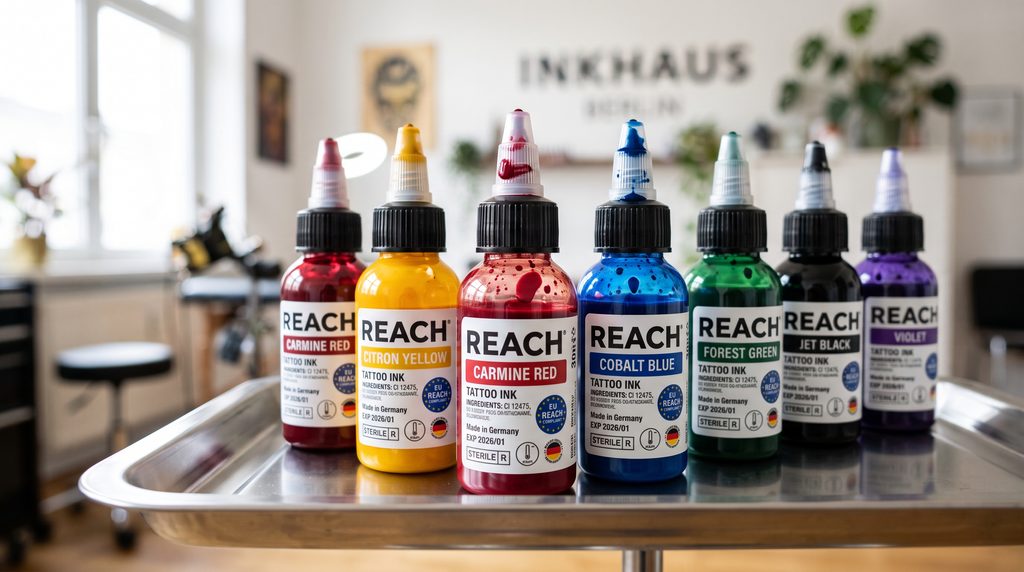
Every bottle opened in a German studio must carry an individual batch tracking code and a dedicated safety data sheet (Sicherheitsdatenblatt). If a batch shows any manufacturing issue, it can be traced and pulled from circulation immediately.
Color Longevity & Technique
Early compliant inks were notorious among artists for being difficult to pack smoothly into the dermis. However, modern second- and third-generation REACH-compliant inks heal crisp, saturated, and stable when handled by an experienced professional.
4. How to Spot a Studio Using 100% Legal, Compliant Ink
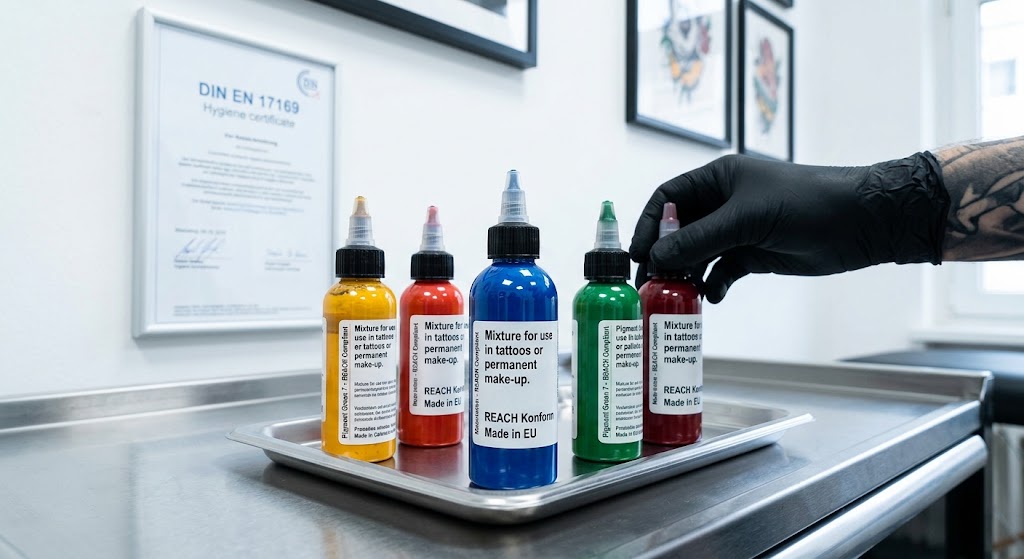
German public health authorities (Gesundheitsamt) conduct unannounced inspections of tattoo studios to verify compliance with DIN EN 17169 and REACH requirements. Reputable studios take immense pride in their safety protocols.
Here is how you can verify your artist is using legal pigments:
- Check the Bottle Labeling: Compliant bottles must feature a clear statement on the packaging:
"Mixture for use in tattoos or permanent make-up."If the label does not feature this exact statement (or its German equivalent: “Gemisch zur Verwendung in Tätowierungen oder Permanent-Make-up”), the ink cannot legally be used on human skin. - Look for Reputable Certified Brands: Leading compliant ink lines commonly used in German ateliers include World Famous Limitless, I AM INK, Kuro Sumi Imperial, Eternal Ink EU, Raw Pigments, and Intenze Gen-Z.
- Inspect the Expiration and Batch Numbers: Every bottle should have an unbroken tamper seal before first use and clearly list both manufacture and expiration dates.
- Transparent Consent Forms: Under German law, your consent agreement (Einwilligungserklärung) will note the ink brands or batch numbers used for your session.
Red Flag Warning: If an artist admits to importing unregulated ink bottles privately from the United States or the UK to “get the old colors,” walk away. Uncertified inks bypass German liability insurance, violate federal health ordinances, and expose your skin to unvetted contaminants.
5. Can You Bring Your Own Ink to a German Studio?
No. Professional artists and studios in Germany will never allow a client to bring their own bottle of ink.
Doing so violates studio hygiene insurance policies. The artist must be able to guarantee the provenance, sterility, and REACH documentation of every drop of pigment that enters their needles.
Frequently Asked Questions (FAQ)
Did the EU REACH regulation make tattoos more expensive in Germany?
Yes, slightly. Reformulating, testing, and certifying sterile inks increased overhead production costs for manufacturers. This slight increase in material expense is typically absorbed into the artist’s studio minimum or general hourly rate.
Will old tattoos done before 2022 cause health problems?
There is no medical consensus suggesting you should laser off or panic over tattoos done before the 2022 regulation. The ban strictly addresses the sale and application of unvetted raw liquid pigments, not existing healed skin art.
Are white and black inks affected by REACH?
Yes. Black and white pigments are subject to the same strict concentration limits for heavy metals and polycyclic aromatic hydrocarbons (PAHs). Compliant black line and shading inks were among the very first formulations certified when REACH took effect.
About The Author

1 thought on “Are Colored Tattoos Banned in Germany? The Truth About EU REACH Ink Regulations”